


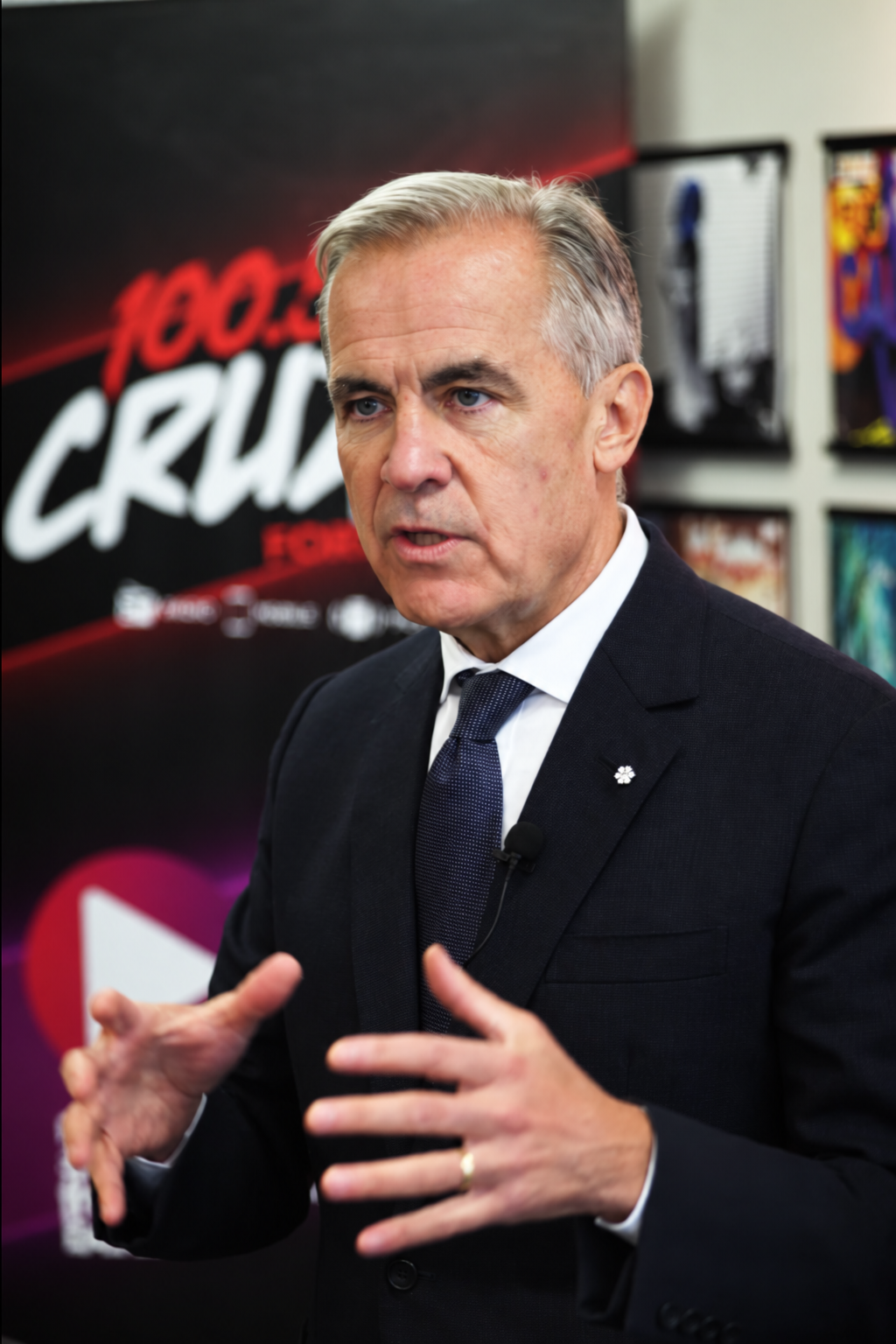
Prime Minister Mark Carney, Harvard Media Studios, Fort McMurray. Oct 1, 2026
FORT MCMURRAY — Prime Minister Mark Carney says expanding existing oilsands mines could be part of the production growth needed as Canada moves ahead with plans for a new West Coast pipeline no called the Pacific Link Pipeline.
Asked during an interview with Harvard Media whether existing mining operations could expand to help supply additional export capacity, Carney said the option remains on the table.
“It is a possibility,” Carney said.
His comments came after the federal government designated the proposed Pacific Link Pipeline as a project of national interest. The project is expected to carry about one million barrels of oil per day to the West Coast for export to Asian markets.
Carney said Ottawa and Alberta are working under a regulatory co-operation agreement intended to reduce duplication between the two governments.
“So where Alberta can make the decision, we don’t duplicate the decisions, and vice versa, where we have jurisdiction expertise, we’ll take those decisions,” he said.
The push for new export capacity comes as some oilsands producers are already looking at major expansions.
Suncor says it is preparing for a significant expansion of Firebag, its largest in-situ oilsands operation, with a proposal that could eventually increase approved production capacity to 700,000 barrels per day.
Firebag, about 120 kilometres northeast of Fort McMurray, uses steam-assisted gravity drainage rather than open-pit mining.
According to Suncor, the operation has nameplate capacity of 215,000 barrels per day and produced a record 245,000 barrels per day in 2025.
The company’s proposed expansion would increase Firebag’s approved production ceiling by 331,500 barrels per day and expand its regulatory footprint.
Suncor’s 2026 investor presentation outlines four future development phases of about 60,000 barrels per day each, with first oil currently targeted between 2032 and 2036.
The company estimates the expansion area contains about three billion barrels of developed resource with a life exceeding 30 years.
Suncor says much of the supporting infrastructure is already in place at Firebag, including roads, pipelines, power infrastructure, lodges and an aerodrome.
Firebag began operating in 2003 and has since produced more than one billion barrels.
The federal government has also changed how in-situ oilsands projects are assessed.
Ottawa announced Sept. 9 that in-situ oilsands extraction facilities are being removed from the federal Project List under the Impact Assessment Act, returning primary assessment responsibility for those projects to applicable provincial processes.
The federal government says the change is intended to keep federal impact assessments focused on major projects with the greatest potential for adverse effects within federal jurisdiction.
In-situ oilsands projects will still be subject to applicable provincial and federal requirements, including environmental protections and the Crown’s constitutional duty to consult and accommodate Indigeno
us Peoples.
Federal Energy and Natural Resources Minister Tim Hodgson said the changes are intended to reduce duplication without lowering environmental standards.
“To make it easier to build major projects, we’re not lowering standards, but raising competence,” Hodgson said.
He said the changes are aimed at creating a more efficient and predictable regulatory system while helping Canada attract investment and move natural resources to domestic and international markets.
Carney also said work surrounding further oilsands development could provide an opportunity to address longstanding questions around oilsands effluent regulations.
“Part of the consultation for this, I think is going to address some of the longer standing issues with the oil sands around effluents, and where are we going to go on that, what are the regulations going to be,” he said.
Carney noted regulation of oilsands effluent involves both levels of government because of federal jurisdiction over water.
“It’s a shared jurisdiction as you know, partly the province, but partly because of the water aspect, the federal government,” he said.
Carney said the process creates an opportunity for Ottawa and Alberta to work with local and Indigenous communities on those issues alongside broader development plans.
“Here’s a chance to move f
orward, move forward in partnership with local communities, with Indigenous communities, and get this right in parallel,” he said.
The prime minister also pointed to federal tax measures intended to encourage new investment, saying they apply to oilsands projects as well as pipelines, mining, telecommunications, research and other industries.
Carney said Canada has lowered the tax rate on new investment to less than half the U.S. rate and less than one-third of the G7 average.
“It is the best fiscal regime in the world,” he said. “In other words, it is the best time in the world for Canadians and the world to invest in Canada, make us stronger.”


Comments